
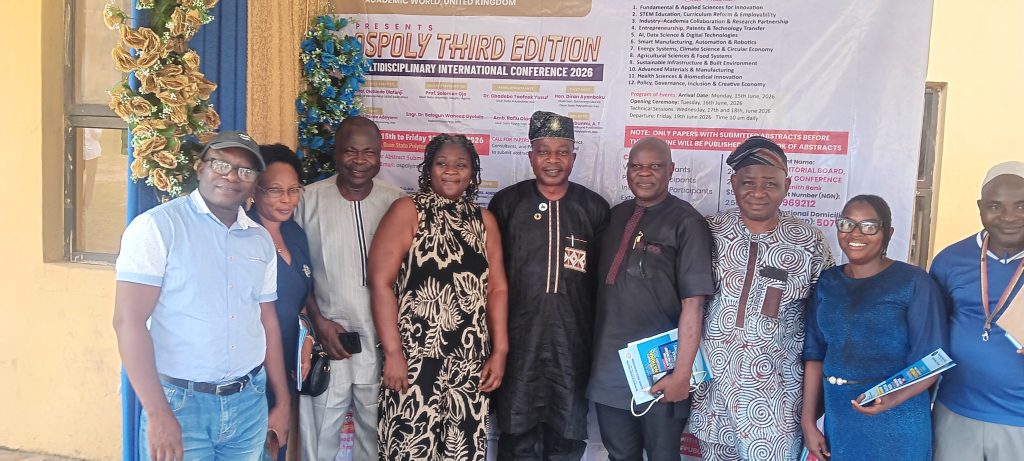
The Third International Multidisciplinary Conference at Osun State Polytechnic, Iree (OSPOLY) with the theme, “Skill, Innovation and Industry Partnership as a Pathway to National Development” brought together more than 500 participants on 16 June 2026. Opening Ceremony Participants include scholars, industry leaders, government officials, and students in a dynamic exchange of ideas on innovation, inclusion, and national development.
The conference featuring panel session, moderated with clarity and balance by Mr. Lekan Adegboye, Secretary of the Conference Organizing Committee, with a compelling presentation by Mr Rafiu Akinpelu Olaore, CEO of Youths Enterprise Development and Innovation Society (YEDIS) and a Chief Lecturer in Procurement and Supply Chain Management in the Institution. His remarks blended gratitude, personal narrative, and systemic analysis, setting the stage for a discussion that resonated deeply with participants.
Acknowledgements
Rafiu Olaore began by thanking the organizers for the honour of serving as a panel discussant and Dr. Kehinde Alabi, Rector of Osun State Polytechnic, for fostering an enabling environment for academic and professional growth.
Gender and Inclusion in Innovation.
When addressing inclusion, Olaore stressed that the challenge is not a lack of talent but unequal access to opportunities. He identified barriers such as limited STEM education in rural areas, gender stereotypes, digital exclusion, inadequate financing for women-led enterprises, and the exclusion of persons with disabilities.
His recommendations included inclusive STEM education, expanded digital literacy and AI training, targeted innovation grants, disability-friendly hubs, and mentorship programmes. His message was emphatic: “National development cannot be sustainable if innovation benefits only a segment of society. Inclusion is not a social obligation alone; it is an economic necessity.”
The Role of State Governments
Olaore argued that state governments, being closest to local realities, are uniquely positioned to drive innovation-led development. He highlighted opportunities in agriculture, tourism, and skills development, urging Osun State to establish innovation hubs, foster public-private partnerships, and integrate AI into its strategies.
His call to action was memorable: “States should not wait for national solutions. They can become laboratories of innovation where local resources are transformed into engines of economic growth.”
Measuring Impact and Accountability
On accountability, Olaore urged a shift from counting graduates to measuring transformed lives. He outlined metrics such as employment outcomes, entrepreneurship survival rates, industry-academia partnerships, and social impact indicators. He called for annual public reporting, independent assessments, and data-driven monitoring systems.
His key message: “Success should not be measured by certificates issued or papers published alone. Success should be measured by jobs created, businesses sustained, innovations commercialized, and communities transformed.”
Closing Reflections
In his closing remarks, Olaore emphasized: “The pathway to national development lies at the intersection of skills, innovation, inclusion, and partnership. We must move beyond isolated interventions and build ecosystems where government, academia, industry, civil society, and communities work together.
When innovation is inclusive, skills are market-relevant, and partnerships are purposeful, sustainable national development becomes achievable rather than aspirational.
The session ended with applause, leaving participants inspired and motivated to pursue collaborative strategies for national growth. Under the steady moderation of Mr. Lekan Adegboye, the discussion not only illuminated challenges but also charted pathways toward solutions.
Memorable Quotes
“National development cannot be sustainable if innovation benefits only a segment of society. Inclusion is not a social obligation alone; it is an economic necessity.”
“States should not wait for national solutions. They can become laboratories of innovation where local resources are transformed into engines of economic growth.”
“Success should not be measured by certificates issued or papers published alone. Success should be measured by jobs created, businesses sustained, innovations commercialized, and communities transformed.”
Moderator’s Feedback
Following the presentation, Moderator Mr. Lekan Adegboye offered a brief interview reflecting on Olaore’s contributions. He praised the clarity of the arguments and the practical recommendations, noting that Olaore’s emphasis on inclusion and accountability provided “a roadmap that institutions and governments can adopt immediately.”
Adegboye highlighted the importance of linking innovation to measurable community outcomes, describing Olaore’s intervention as “both visionary and actionable.”
Audience Reactions and Partnerships
As the session concluded, academic participants and industry representatives approached Rafiu Akinpelu Olaore to congratulate him on his impactful presentation. Several expressed interest in collaborating with his NGO, the Youths Enterprise Development and Innovation Society (YEDIS), to advance inclusive development initiatives.
The spontaneous engagement underscored the resonance of his message: innovation must be inclusive, skills must be market-relevant, and partnerships must be purposeful. The eagerness of participants to connect with YEDIS reflected a shared commitment to translating ideas into tangible outcomes for communities.