
YEDIS Convenes Global Stakeholders on Green Entrepreneurship at World Bank Group–IMF Annual Meetings in Bangkok
Bangkok, Thailand | 15 October 2026
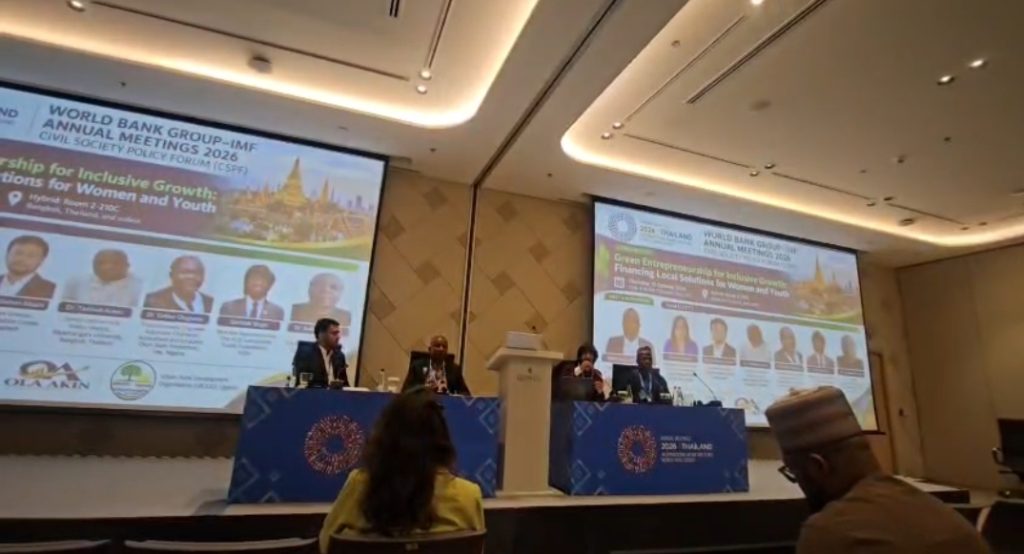
The Youths Enterprise Development & Innovation Society (YEDIS), a Nigerian civil society organisation with Special Consultative Status with the United Nations Economic and Social Council (ECOSOC), convened and led a Civil Society Policy Forum session during the 2026 World Bank Group–International Monetary Fund (IMF) Annual Meetings in Bangkok, Thailand.
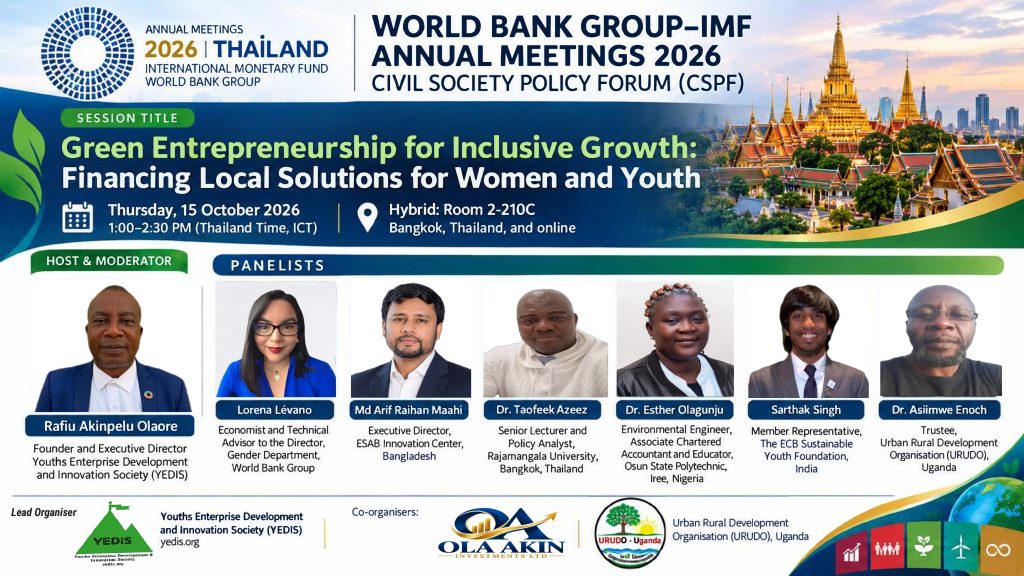
The session, titled “Green Entrepreneurship for Inclusive Growth: Financing Local Solutions for Women and Youth,” examined how accessible financing, green entrepreneurship, grassroots innovation and institutional partnerships can create sustainable economic opportunities for women and young people, particularly in underserved communities.
Held from 1:00 p.m. to 2:30 p.m. on 15 October at Room 2-210C, Queen Sirikit National Convention Center, the session brought together experts and stakeholders from Bangladesh, Thailand, India, Uganda and Nigeria to discuss practical approaches to financing local solutions, strengthening green enterprises and creating sustainable employment.
Connecting Grassroots Innovation with Development Finance
The session was moderated by Rafiu Akinpelu Olaore, Founder and Executive Director of YEDIS, who emphasised the importance of examining the entire enterprise development pathway—from skills acquisition and innovation to technology, production, market access, financing and business growth.
His opening remarks highlighted the additional barriers faced by women and young people in underserved communities, particularly when they lack access to appropriate financing, market opportunities and institutional support.
The discussion was guided by three central questions:
- What needs to change?
- Who needs to act?
- How can we measure whether the change is making a difference?
These questions framed the conversation around moving beyond entrepreneurship training alone towards integrated support systems that enable women- and youth-led enterprises to establish, grow and sustain viable businesses.
Distinguished Panellists
The session featured contributions from six panellists representing international development, economics, academia, sustainability and youth-led civil society:
- Lorena Lévano — Economist and Technical Advisor to the Director, Gender Department, World Bank Group.
- Md Arif Raihan Maahi — Executive Director, ESAB Innovation Center, Bangladesh.
- Dr. Taofeek Azeez — Senior Lecturer and Policy Analyst, Rajamangala University, Bangkok, Thailand.
- Dr. Asiimwe Enoch — Trustee, Urban Rural Development Organisation, Uganda.
- Dr. Esther Olagunju — Environmental Engineer, Associate Chartered Accountant and Educator, Osun State Polytechnic, Iree, Nigeria.
- Sarthak Singh — Member Representative, The ECB Sustainable Youth Foundation, India.
The contributions explored the importance of financing mechanisms, technology adoption, market access and cross-sector partnerships in supporting green micro, small and medium-sized enterprises (MSMEs).
Advancing Practical Solutions for Women and Youth
A central theme of the session was the need to connect entrepreneurship development with the resources required to translate skills and innovation into sustainable economic outcomes.
Participants considered how governments, development finance institutions, private-sector actors, academia and civil society can work together to improve access to finance, strengthen local enterprises, support climate-smart business practices and create decent jobs.
The discussion reinforced the importance of locally driven solutions that respond to the realities of underserved communities while contributing to wider development priorities.
For YEDIS, these priorities align with its ongoing work in youth entrepreneurship, women’s economic empowerment, digital inclusion, climate action and sustainable community development.
Building on YEDIS’s Grassroots Digital Innovation Work
The Bangkok engagement builds on YEDIS’s initiative, Digital Capacity-Building and AI Integration for Rural Women and Youth Agribusiness Processors, which was featured by the United Nations Office for South-South Cooperation (UNOSSC) on the South-South Galaxy platform in July 2026.
Commencing in 2026, YEDIS’s digital agriculture and green entrepreneurship initiative aims to empower more than 1,000 smallholder farmers by 2027 through digital capacity-building, AI integration and sustainable agribusiness practices.
By connecting grassroots programme experience with international policy dialogue, YEDIS seeks to strengthen the visibility of local solutions and promote wider discussion on the financing and institutional support needed to scale them.
Partnerships for Inclusive Growth
YEDIS acknowledges the contributions of all panellists, participants and stakeholders who supported the session. The organisation also recognises its co-organising partners, Ola Akin Investments Ltd and Urban Rural Development Organisation, Uganda, for their support.
The participation of stakeholders from five countries provided an opportunity to exchange perspectives and explore areas for continued collaboration on green entrepreneurship, inclusive financing and sustainable development.
Watch the Full Session
The full session recording is available on the World Bank Group’s official YouTube channel.
Watch here:
YEDIS remains committed to advancing practical, locally driven solutions that connect grassroots innovation with inclusive financing, enterprise development and sustainable employment.
Local solutions. Inclusive finance. Sustainable impact.
About YEDIS
The Youths Enterprise Development & Innovation Society (YEDIS) is a youth-focused civil society organisation working to promote entrepreneurship, innovation, digital inclusion, women’s economic empowerment, climate action and sustainable community development. YEDIS holds Special Consultative Status with the United Nations Economic and Social Council (ECOSOC).