
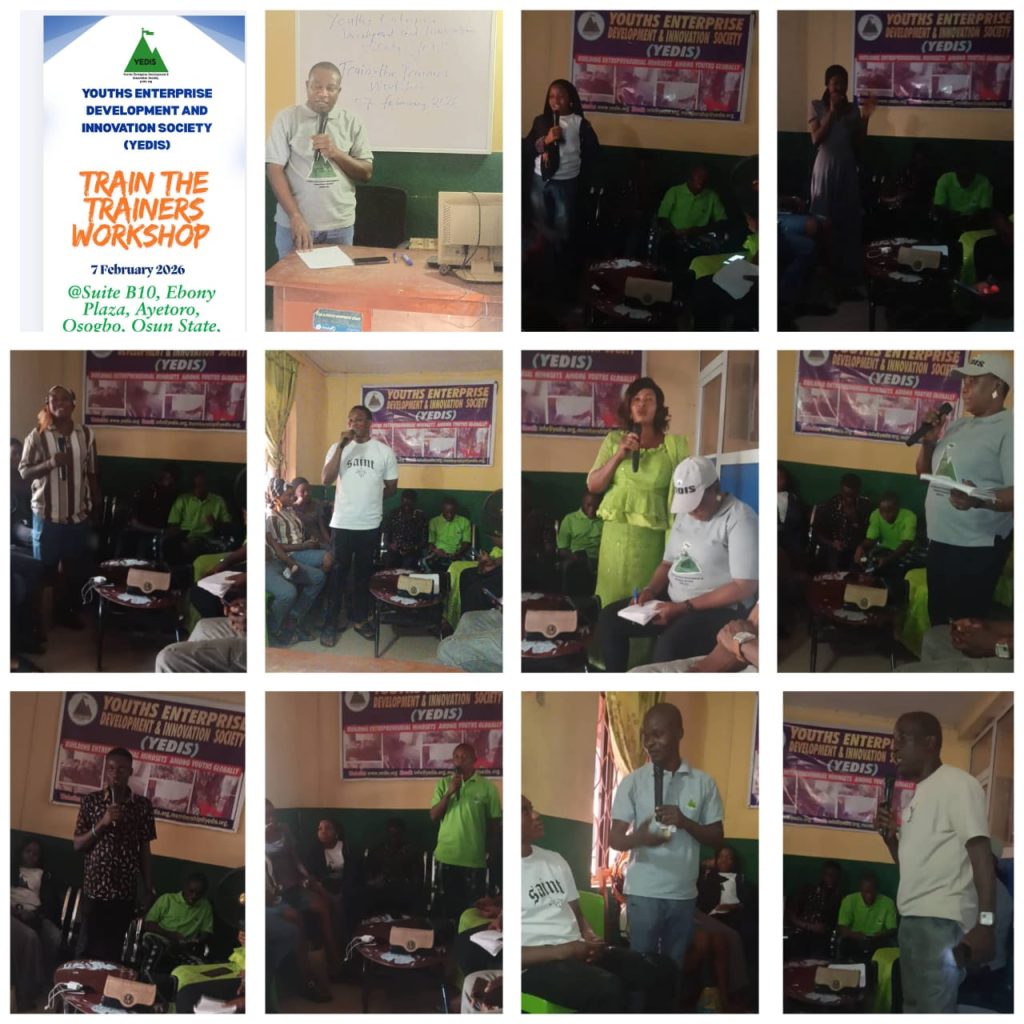
The Youths Enterprise Development and Innovation Society (YEDIS) held a key ‘train the trainers’ workshop on Saturday, February 7, 2026, at its headquarters in Osogbo, Osun State, Nigeria. The event brought together YEDIS coordinators from 15 zones across Southwest Nigeria to develop skills in artificial intelligence (AI), digital technology, and leadership, to boost impactful community development.
The main aim is to leverage AI and digital innovation to create employment opportunities, particularly for marginalised groups, including women and youth in agriculture. The workshop also provided a platform for capacity building, project planning, and strategic partnership development.
Keynote & Leadership Insights:
Led by CEO Mr Rafiu Olaore, the keynote speech offered insights from his limited experience with AI and digital technology, as well as YEDIS’s accomplishments. He highlighted YEDIS’s 2026 work with United Nations programmes, including a celebration of the International Day of Education with nearly 500 underserved students in Osun State.
He also discussed earlier projects with educational institutions like the Federal Polytechnic, Ayede-Ogbomoso, and the University of Lagos (UNILAG) OWSD, focusing on entrepreneurship, AI, and employment creation. Mr Olaore stressed YEDIS’s implementation of 10 community projects in 2025 and its participation in global events across Italy, France, Switzerland, the USA, Canada, Qatar, and African nations, aimed at influencing policy on meaningful employment in developing countries.
In his submission, Mr Olaore stated that ‘disruptive innovation’ is essential for success in a competitive business environment. He further recounted an inspiring remark from Mrs Taiwo, a YEDIS beneficiary from Ifelodun in Osun State. She noted that the agricultural tools and digital innovation training provided by YEDIS have significantly improved her palm oil production, enabling expansion across five rural communities and creating employment opportunities for others.
Capacity Building & Certification Programmes:
Mr Olaore mentioned the involvement of the YEDIS management team in the World Bank Group and Nigerian Federal Government’s SPESSE certification program in the “Foundation Social Standards Certified Professional’ scheme, along with AI and digital skills training to boost expertise. He emphasised that the 2026 ‘train the trainers’ workshop aims to prepare YEDIS teams to implement technology-driven solutions for social activities within marginalised communities as part of their routine tasks.
Second Session: Digital Agriculture:
A key focus was digital agriculture, targeting smallholder farmers, women, and girls in rural sectors.
The team detailed strategic plans for 2026, including fundraising to support capacity building, distributing agricultural equipment, and training on AI applications to promote employment.
CEO Rafiu Olaore stated that YEDIS aims to reach 5,000 underserved smallholder farmers in Nigeria in 2026. The plan includes supporting value chain actors, such as vulnerable traders and manufacturers, by training them in AI and digital skills and providing tools to increase productivity, employment, and profits.
Action Plan & Participant Contributions:
During a practical session, participants shared their AI and digital innovation experiences and contributed to strategic planning.
The workshop concluded with commitments to implement projects that empower underserved youth, particularly women and girls in agriculture.
Acknowledgements & Appreciation:
Members thanked stakeholders, including NGOs, private-sector entities, individuals, and community leaders, for their support, donations, venue space, and facilitation. They acknowledged community partners involved in organising and hosting the event.
They also appreciated positive feedback from beneficiaries, which boosts YEDIS’s reputation. Their efforts have made YEDIS a globally recognised organisation, with the CEO and members now able to influence international policies.
Participant Names:
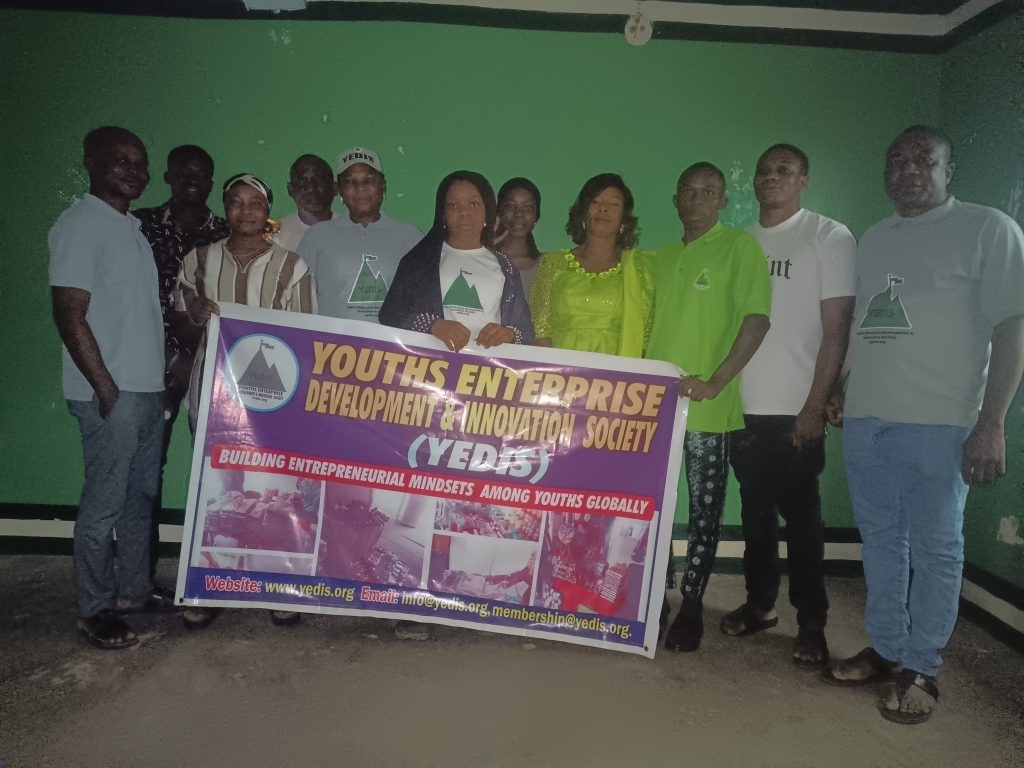
Participants included young representatives from marginalised communities across Nigeria, such as Mr Adeoye Opeyemi, Mrs Mary Adebayo, Mr Opeyemi Abass, Miss Alimah Olaore, Mrs Alaje Grace, Miss Waliyat Oyerinde, Miss Karimah Olaore, Mr Ojo Ayobami, Mr Oladele Taiwo, Mr Yushuf Ismaila and Mrs Lateef Rukayat, and online participants, Miss Shipeolu Johnson Ibukunoluwa, Mr Lawal Abdulquadri, Mr Soliu Dauda, Mr Yekini Ibrahim, and Mr Lawal Isiaq.
YEDIS calls for support and partnerships from the government, international agencies, civil society, academics, philanthropists, and the private sector to effectively implement projects that generate employment nationwide.
This workshop marked a milestone in the YEDIS team’s capacity building, setting a clear roadmap for social activities in 2026 and beyond.
Video link: